MAT223 Lecture 08
- 4
- 5
- Compute
- Easier method is Upper-Triangular Matrix
- See that the determinant is the product of diagonal things.
- Transpose does not affect determinant.
- 6
- If and
- Then
- Reduce the matrix and then take the determinant to make it easier.
- Theorem 1:
- Let be an matrix:
- If has a row of s, then
- If we exchange two rows of , the determinant of the resulting matrix is
- If we multiply an entire row of by , the determinant is
- If you add a multiple of one row to another, the determinant is unchanged.
- Activity 2
- 1
- Let
- is the matrix obtained by performing
- Scale by
- Swap row 1 and 2
- Verify
- True
- 2
- Let
- Transform into an Upper-Triangular Matrix only using adding and subtracting multiples of rows
- Transform into an Upper-Triangular Matrix using any row operation.
- 3
- Find the
- Upper-Triangular Matrix
- 4
- Come up with a strategy for computing the determinant of a matrix in a quick way.
- If are invertible matrices, which of the following other matrices must be invertible.
- Invertible
- Not invertible
-
- Not invertible
- Determinant properties can tell us this:
- Invertible
-
- Two nonzero can't give you a 0
-
- which is not
-
- Activity 3
- Assume that and are
- If has two equal rows, then is not invertible.
- True, without loss of generality suppose
- We can then do
- Resulting in
- A row of s results in the determinant being by theorem.
- Invertibility requires that
-
- False, this is not a property of determinants.
- Counterexample:
- Let
-
- 3
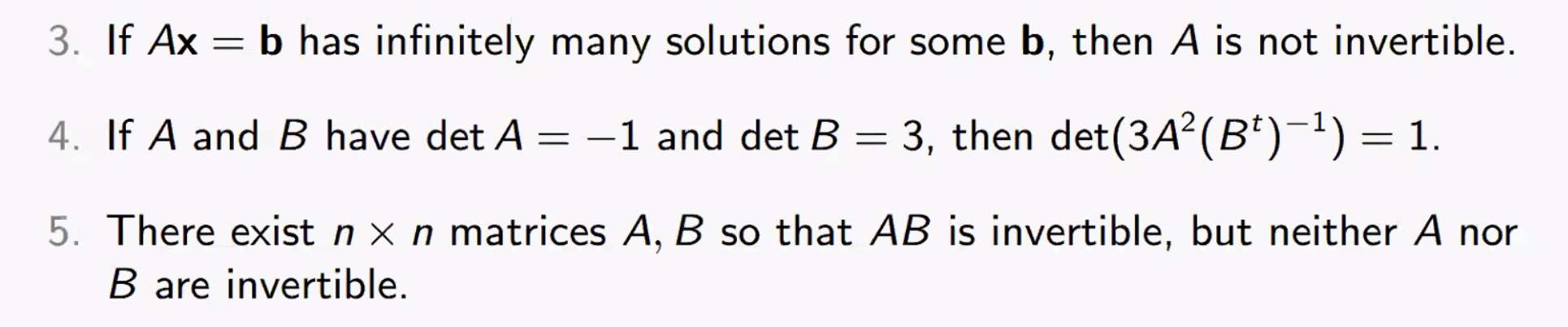
- If has infinitely many solutions for some , then is not invertible.
- False, counterexample:
- So for any we have infinite solution.
- If and have